Lubricants & Maintenance
Engine Oil Grade Comparison: 5W-30 vs 10W-40 vs 20W-50 — Which Is Right for Your Fleet?
Tags
Share this article
France AJ Group explains the key differences between popular engine oil viscosity grades — 5W-30, 10W-40, and 20W-50 — and how to choose the right Antar lubricant grade for your fleet, climate, and engine type.
One of the most common questions from fleet managers, automotive workshops, and wholesale lubricant buyers is: what is the difference between engine oil grades, and which one should I order? Through its lubricant division Antar Engine Oil, France AJ Group supplies the complete range of Antar engine oils — diesel and gasoline, mineral and fully synthetic — to B2B buyers, distributors, and fleet operators worldwide. This guide cuts through the technical language and explains exactly what viscosity grades mean and how to choose correctly.
What Do Engine Oil Grades Mean?
Engine oil grades are defined by the SAE (Society of Automotive Engineers) viscosity classification system. Every grade you see on a label — 5W-30, 10W-40, 20W-50 — tells you two things:
- The "W" number (e.g., 5W, 10W, 20W) indicates the oil's cold-weather viscosity. The lower this number, the better the oil flows in cold temperatures and the faster it reaches critical engine components on a cold start. "W" stands for Winter.
- The second number (e.g., 30, 40, 50) indicates the oil's viscosity at operating temperature (100°C). The higher this number, the thicker the oil film at running temperature — providing greater protection under high load and heat.
Multi-grade oils (like 5W-30 or 10W-40) behave like a thin oil in the cold and a thicker oil when hot, offering the best of both worlds. Mono-grade oils (like SAE 50 or SAE 60) have a single viscosity rating, designed for specific operating conditions.
5W-30: The Modern Efficiency Standard
5W-30 is today's most widely recommended viscosity grade for modern gasoline passenger cars and light commercial vehicles. It is the default factory-fill oil for the majority of European, Japanese, and American vehicles manufactured after 2010.
Key characteristics:
- Excellent cold-start flow at temperatures down to −30°C
- Moderate operating viscosity — low enough to reduce internal friction and improve fuel economy
- Compatible with most modern emission control systems (DPF, GPF, TWC)
- Typically available in fully synthetic formulations (API SN, SP, ACEA A3/B4)
Best for: Modern passenger cars, light SUVs, urban delivery vehicles, mild to temperate climates, fuel economy-focused fleets.
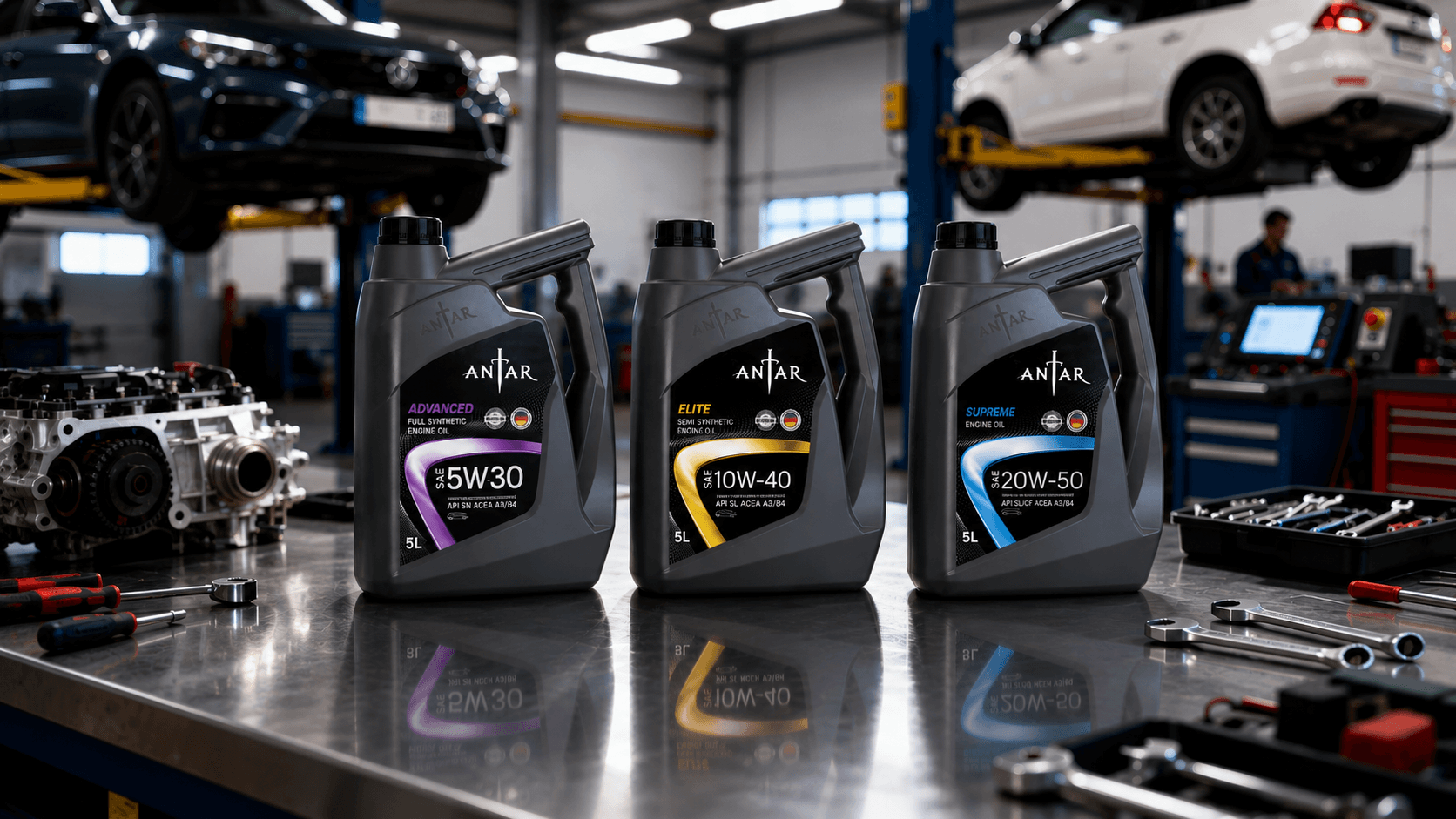
Antar equivalent: Antar Advanced Fully Synthetic 5W-30 API SN — formulated for passenger cars and light-duty vehicles requiring maximum fuel economy and long drain intervals.
10W-40: The Versatile Fleet Standard
10W-40 is the most popular all-purpose engine oil grade for mixed-fleet operations worldwide. It strikes a balance between cold-start protection, high-temperature stability, and wide compatibility across a range of engine types and ages — making it the default choice for fleet workshops that service multiple vehicle types.
Key characteristics:
- Good cold-start flow down to −25°C
- Higher operating viscosity than 5W-30 — better film strength for older engines with larger clearances
- Suits both gasoline and diesel engines in the SL/CF or CI-4 API category
- Available in synthetic blend and full synthetic formulations
Best for: Mixed fleets (cars + light trucks), older vehicles, workshops serving diverse engine types, temperate to hot climates, markets in Africa and the Middle East where ambient temperatures regularly exceed 35°C.
Antar equivalents:
- Antar Elite 10W-40 API SL/CF — synthetic blend for gasoline and light diesel engines
- Antar MaxFlow CK-4 10W-40 — full synthetic for modern heavy-duty diesel fleets with EGR/SCR/DPF systems
20W-50: The Hot Climate Heavy-Duty Standard
20W-50 is a high-viscosity multi-grade oil designed specifically for hot climates and older, high-mileage engines. It was the global default for passenger cars in the 1970s–1990s and remains the preferred grade for markets in Africa, the Middle East, and South Asia where average ambient temperatures exceed 40°C and older vehicle populations are large.
Key characteristics:
- Cold-start flow down to −15°C — suitable for moderate cold starts but not designed for sub-zero environments
- High operating viscosity — maximum oil film thickness under heat and load, ideal for worn engine clearances
- Strong protection against oil consumption in high-mileage engines
- Available in mineral, semi-synthetic, and diesel-specific formulations
Best for: Older vehicles, high-mileage engines, hot climate markets (Sub-Saharan Africa, Gulf region, South Asia), heavy-duty trucks and buses with older diesel engines, industrial machinery.
Antar equivalents:
- Antar Supreme 20W-50 API SL/CF — high-viscosity multi-grade for gasoline and diesel vehicles in hot climates
- Antar Maximus CH-4 20W-50 — heavy-duty diesel 20W-50 for turbocharged trucks and industrial fleets
Side-by-Side Grade Comparison
| Parameter | 5W-30 | 10W-40 | 20W-50 |
|---|---|---|---|
| Cold-start performance | Excellent (−30°C) | Good (−25°C) | Moderate (−15°C) |
| Operating viscosity | Low–moderate | Moderate–high | High |
| Fuel economy benefit | High | Moderate | Low |
| Hot climate suitability | Moderate | Good | Excellent |
| Older engine compatibility | Limited | Good | Excellent |
| Modern emission system safe | Yes (low-SAPS) | Depends on spec | Generally no |
| Typical formulation | Full synthetic | Synthetic blend / full synthetic | Mineral / semi-synthetic |
Mono-Grade Diesel Oils: SAE 50, 60 and 70
For heavy-duty stationary engines, industrial pumps, and generators operating under constant-load conditions in extreme heat, Antar also offers mono-grade diesel oils:
- Antar HD-50 CF-4 — SAE 50 mono-grade for heavy-duty trucks and buses in high-temperature regions
- Antar HD-60 CF-4 — SAE 60 for extreme heat and high-load industrial applications
- Antar HD-70 CF-4 — SAE 70 for stationary engines and pumps operating in the most severe duty conditions
How to Choose the Right Grade for Your Fleet
- Check the manufacturer specification first. The vehicle owner's manual and engine data plate specify the approved viscosity grade. Always start here — using the wrong grade can void warranty coverage and reduce engine protection.
- Consider your climate. Hot markets (Africa, Gulf, South Asia) generally favour higher operating viscosity grades (10W-40, 20W-50) to maintain adequate film strength at elevated sump temperatures. Cold climate operations favour lower W-grades (5W-30, 5W-40).
- Factor in engine age and condition. Newer, tighter-tolerance engines are designed for thinner oils (5W-30). Older, high-mileage engines with larger clearances retain operating pressure better with thicker grades (10W-40, 20W-50).
- Match the API standard. Diesel engines require CI-4, CK-4, or CH-4 rated oils. Gasoline engines require SN, SP, or SL-rated oils. Never use a diesel-only rated oil in a gasoline engine without checking cross-compatibility.
"The right oil grade is not about picking the most expensive option — it is about matching viscosity to your engine specification, climate, and duty cycle. Antar's full range covers every combination, and our trade team can help fleet buyers select the correct SKU for their application." — France AJ Group Representative
B2B Ordering: Packaging and MOQ
France AJ Group supplies all Antar engine oil grades in standard B2B packaging: 1L bottles, 4L cans, 25L pails, and 208L drums. Minimum order quantity (MOQ) starts at 1 pallet, with full container and bulk shipment pricing available for large-volume buyers. Contact our trade team for a Proforma Invoice and current wholesale pricing.
About France AJ Group & Antar Engine Oil
France AJ Group is an international B2B trading conglomerate with operations in food commodities, electric vehicles, lubricants, and building materials. Antar Engine Oil, its lubricant division, distributes the complete Antar engine oil catalog to wholesale buyers, fleet operators, and distributors across Africa, Asia, the Middle East, and Europe.
Read More
Related Articles

Food & Agriculture
Crude Soya Oil Exports to Morocco: France AJ Group Market Entry
France AJ Group, through its food division France AJ Alimentaire, launches a strategic initiative to supply crude soya oil to Morocco, supporting local refining, food security, and industrial growth.

Events & Exhibitions
France AJ Alimentaire to Showcase at Saudi Food Manufacturing 2025 in Riyadh
France AJ Alimentaire announces its participation in Saudi Food Manufacturing 2025 in Riyadh, presenting HALAL-certified food products and B2B solutions for the Middle East food industry.

Events & Exhibitions
France AJ Alimentaire at The Saudi Food Show 2025, Riyadh
France AJ Alimentaire joins The Saudi Food Show 2025 in Riyadh, presenting HALAL-certified food products and B2B solutions for the Middle East food industry.
Want to Learn More?
Explore our companies and discover how France AJ Group can support your business needs
Explore Our Companies